What You'll Learn
- How local context should shape a Central Valley marketing plan
- Five connected parts of a practical customer-acquisition system
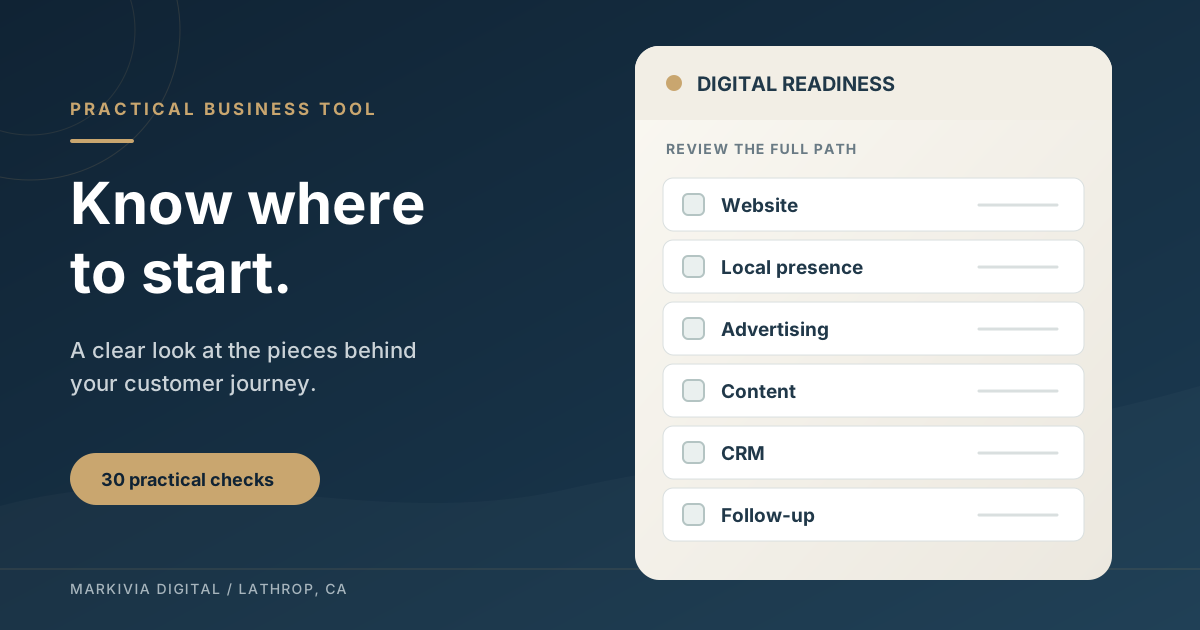
- How websites, advertising, local visibility, content, CRM, and follow-up support one another
- A focused way to choose the next improvement
Why Local Marketing Looks Different in the Central Valley
Businesses in Lathrop, Manteca, Tracy, and Stockton operate across different service areas, customer needs, levels of competition, and buying cycles. A useful plan should reflect the actual market rather than copying a generic national template.
Local search, referrals, community relationships, advertising, and mobile website visits can all influence the customer path. The right mix varies by business, so the first job is to understand where current inquiries come from and what happens after someone shows interest.
A focused Central Valley digital marketing strategy is built around three principles:
- Local intent first
- Trust signals over hype
- Lead capture, not just awareness
Five Connected Parts of the Customer Path
You do not need every channel. You need the right ones, set up properly, and connected to one another.
1. A Clear Website or Landing Experience
Your website is one important part of the customer path. Ads, search, social, and referrals may lead to a website, landing page, call, native lead form, message, or booking flow depending on the offer and customer need.
A modern local business website should:
- Load reliably and feel responsive on common mobile connections
- Clearly answer what you do, who you serve, and where
- Have visible service areas like Lathrop, Manteca, Tracy, and Stockton
- Make calling, messaging, or booking effortless
- Include real photos and real reviews
These foundations give referrals, search visitors, and paid campaigns a clearer destination.
2. Local Visibility and Google Business Profile
Many local buying journeys include a search for a nearby provider, a specific service, or a business already recommended by someone else.
Local visibility work helps search engines and customers understand the services, locations, and pages relevant to those searches.
The foundation is simple:
- A complete, optimized Google Business Profile
- Consistent business information across the web
- Location relevant pages on your website
- Fresh reviews on Google
Google Business Profile can appear in Search and Maps before a customer reaches a website. It should help people verify the business and choose an appropriate next step. Keep the name, address, phone number, hours, photos, updates, and review responses accurate and current.
3. Advertising and Campaign Content
Content marketing for local businesses is not about going viral. It is about building trust and visibility.
Depending on the offer and audience, that can include:
- Planned business visuals for ads, websites, Google, and social
- Project showcases and before and after content
- Educational posts that answer real customer questions
- Short form video that shows your work in action
For service and property businesses, planned business content can create useful video, photography, and project visuals for ads, service pages, Google, and social channels.
4. Lead Capture and Follow Up
Generating clicks is not the same as generating customers.
A lead system helps the team capture, organize, and respond to interest. That includes:
- Clean contact forms with no friction
- Quick reply email templates
- Simple CRM to track inquiries
- Automated reminders so leads do not slip through
For many service businesses, a clear and timely follow-up process makes it easier to respond while the customer's request is still current.
5. Measurement and Improvement
Review where inquiries originate, whether calls, forms, messages, and bookings are handled, and what happens after the first response. Use qualified inquiries, lead quality, conversion actions, and business capacity to guide the next improvement, not clicks alone.
How to Combine It All Into One System
These parts are easier to improve when they are treated as one connected system:
- A Google Business Profile helps customers verify local information
- A website, landing page, call, form, or message path explains or carries the next step
- Campaign content and reviews add relevant context
- A lead capture system records the inquiry
- Follow-up gives the team a dependable response process
Connecting these pieces also makes measurement more useful because the team can see where interest starts and where the process needs attention.
A Realistic Plan for the Next 90 Days
You do not need to do everything at once. A simple sequence works better.
Month 1: Fix the foundation. Audit your website speed, clarity, and mobile experience. Update or rebuild if needed.
Month 2: Strengthen local visibility. Optimize your Google Business Profile, clean up local listings, and start collecting fresh reviews.
Month 3: Run one focused growth test. Create the required campaign assets, improve the relevant service page, connect a simple contact and CRM flow, and test one audience and offer.
At the end of the quarter, review what was completed, what customers actually did, and which part of the system deserves the next investment.
Key Takeaway: Digital marketing for Central Valley local businesses works best when it is local first, trust focused, and built as one connected system. Pick the right channels, set them up properly, and connect them to a clear lead path.
Where to Start
If you are a local business in Lathrop, Manteca, Tracy, or Stockton and the marketing process feels disconnected, start by reviewing the website, Google Business Profile, active campaigns, and lead flow together.
Talk through your project with Markivia Digital and we can help identify which part of the website, campaign, content, or follow-up process needs attention first.